Contact / Donate
Let’s talk.
Share or partner. We read every message.
A historic flood — and Florida's ranchers need hay
As of 5:15–5:30 AM ET, Friday, November 27, 2026, NOAA.
This is a historic flood. Three official gauges on the St. Johns River now stand above NOAA's listed historic records: Cocoa at SR 520 is at 18.27 feet in major flood (NOAA's official historic record is 17.55 feet on October 11, 1953). The forecast is about 18.3 feet today, 18.2 feet Saturday and Sunday, 18.1 feet Monday through Tuesday afternoon, then 18.0 feet, easing to 17.9 feet by Thursday, December 3. Christmas at SR 50 is at 12.62 feet, above its official 2022 record of 11.66 feet; and the gauge above Lake Harney is at 13.17 feet in major flood, above NOAA's official record of 12.67 feet on October 3, 2022. The forecast is 13.2 feet through Saturday morning, easing to 12.9 feet Wednesday, December 2, and 12.8 feet Thursday, December 3.
At Sanford, the river is in major flood at 8.82 feet, still 0.14 feet under Hurricane Ian's official record of 8.96 feet on October 9, 2022. The forecast is 8.8 feet through early Wednesday morning, December 2, still short of Ian.
Harvest & Herds is Harvest Sentinel Alliance's hay run for flood-affected Florida cattle producers. Gifts buy hay and deliver it to the Florida Cattlemen's Foundation emergency depot in Okeechobee. The need is real in two flood areas.
Okeechobee (outside the St. Johns basin) has 157,001 cattle (2022 Census, Table 11). On November 9, the Florida Cattlemen's Association and the Florida Cattlemen's Foundation opened the hay depot there. About 50 ranchers collected hay and feed that first day, Lake Okeechobee News reported.
Brevard, on the upper St. Johns, has 23,448 cattle. About 22,850 acres of pasture sit below today's record river level — an estimate from ground height and the USDA cropland map, and that ceiling could be off by about half either way. Radar from November 17 shows open water on about 730 acres, a floor (a minimum), because the pass came before the later rain and the record crest, and radar misses shallow water in grass. The true flooded acreage sits between those two figures. Some stretches could stay high for two to three months (321 Daily, citing the water district). The hay need is now.
Okeechobee, Osceola, and Brevard together hold about 280,000 cattle on about 900,000 acres of pasture (2022 Census). No agency has published loss figures yet. UF/IFAS opened a loss survey on November 23.
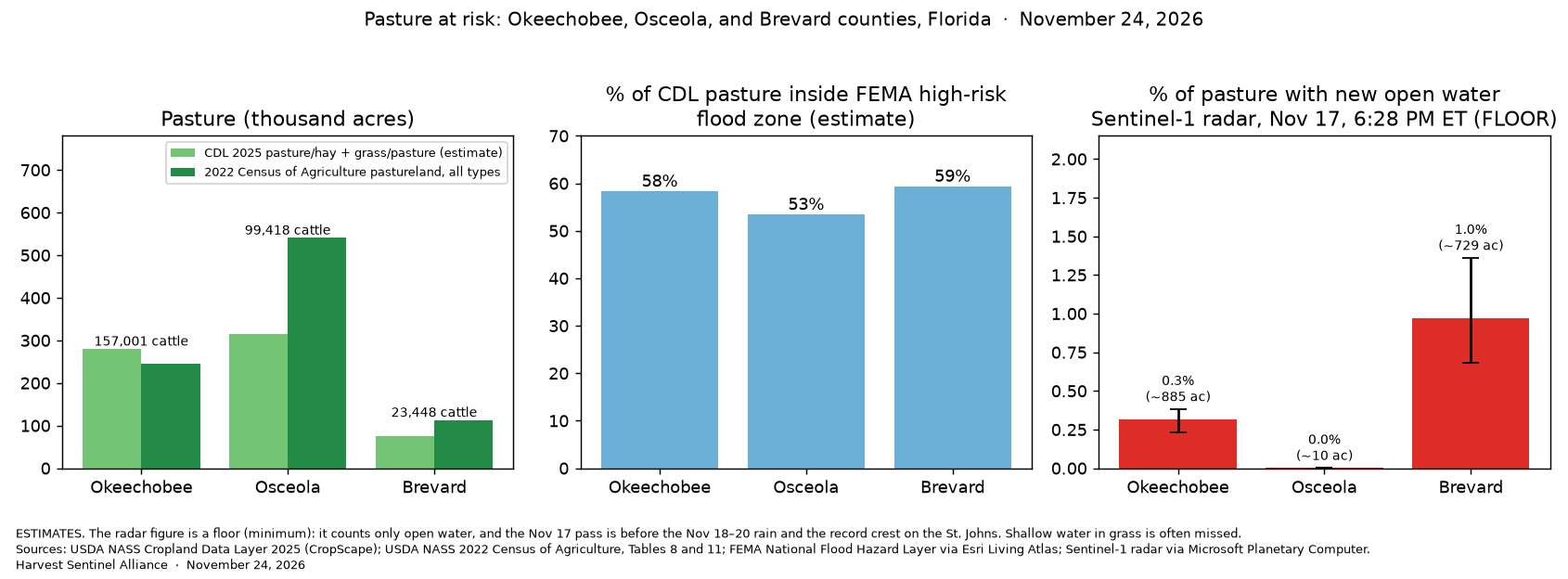
Pasture acres, the share in FEMA high-risk flood zones, and the November 17 radar floor for new open water. The radar figure is a minimum.
The campaign goal is $10,000. Give to Harvest & Herds. Help us get hay to the herd.
Homes and communities along the St. Johns are on our Disaster Response update.
Prepared by Sentinel Intelligence.
Stand with the people who feed you.
Your support builds ethical sourcing traceability hubs, powers community engagement, equips farmers with safer, advanced harvesting methods, and deploys disaster response teams exactly where they are needed most. Harvest Sentinel Alliance is a Delaware nonprofit. Gifts made through this page support our US-based deployment and mission operations only.
Harvest Sentinel Alliance is a fiscally sponsored project of Fiscal Sponsorship Allies, Inc., a 501(c)(3) public charity. Fiscal Sponsorship Allies is our fiscal sponsor and exclusive donation processor, and has variance power over these gifts, meaning it retains the exclusive right to spend them for permissible charitable purposes.
Donations to Harvest Sentinel Alliance through this page are made to Fiscal Sponsorship Allies and are tax-deductible to the extent allowed by law. Fiscal Sponsorship Allies will send your donation receipt. Charges may appear on your bank statement as Fiscal Sponsorship Allies Inc or similar.
Send us a message
Messages go to [email protected].